Choose a mode
Many platforms offer a no-registration demo mode, as well as real money play after topping up your balance.

Discover the dynamic world of Plinko — an online game inspired by Japanese Pachinko that has become especially popular thanks to modern digital versions.
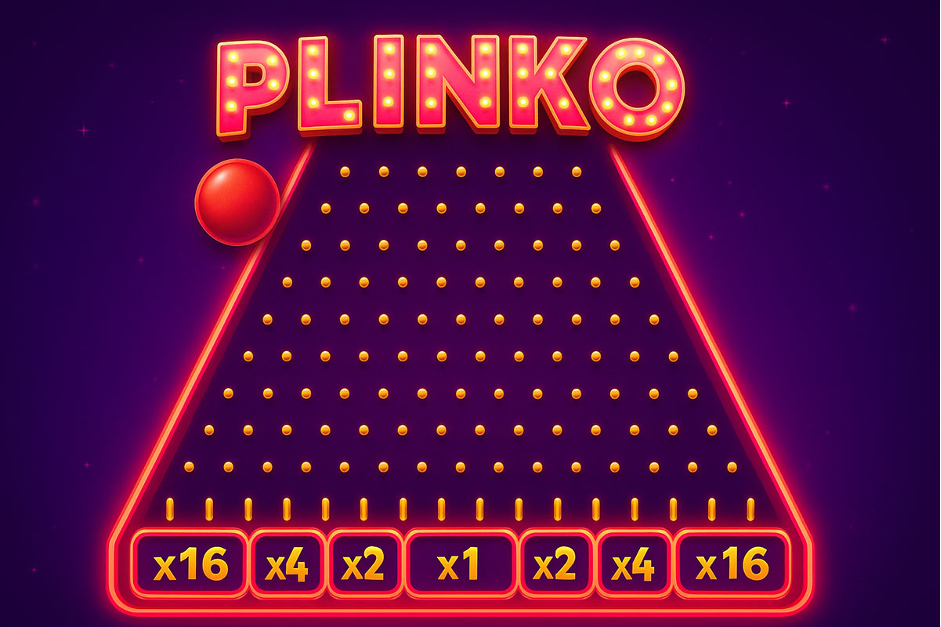
Plinko is one of the easiest online casino games to understand, but behind its apparent simplicity there are many important details. On the screen, the player sees a board with pins, a ball, risk settings, the number of rows, and multipliers placed in the lower part of the field. At first glance, the rules seem explainable in one minute: choose a bet, launch the ball, and wait to see which sector it lands in. However, if we look at the topic of “Plinko rules and conditions” in full, it includes not only the basic player actions, but also RTP parameters, the specifics of risk levels, how multipliers work, the conditions of demo mode, the rules of real money gameplay, fairness principles, and the legal background important for users.
Modern Plinko became widely popular thanks to the digital versions of BGaming, Spribe, and other providers. At the same time, the game logic has remained faithful to the original concept: the ball falls from top to bottom, collides with obstacles, and then randomly moves left or right until it eventually enters one of the bottom cells assigned a specific multiplier. That multiplier determines how much the player receives at the end of the round. However, exactly how multipliers are distributed, how often large values appear, and what limitations apply on a given platform are all part of the game conditions that should be understood before placing a bet.
The most important rule of Plinko is very simple: before each drop, the player chooses the bet amount and, depending on the game version, configures the board parameters. After that, the ball is launched, and the system calculates the result based on which sector the ball reaches after passing through the field. The payout is equal to the bet multiplied by the multiplier received. If the ball lands in a low-multiplier cell, the final result may be lower than the bet amount or roughly equal to it. If it reaches a rare high-multiplier field, the payout rises sharply.
This means that in Plinko there are no traditional paylines, reels, bonus symbols, or free spins as in slot machines. Everything here is built around the drop path and the configuration of the board. The player does not collect combinations, activate separate bonus rounds, or choose a cashout moment as in other crash games. The entire round is concentrated into one action: launching the ball and accepting the result after it passes through the board.
Although the basic mechanic remains the same, the actual gameplay conditions are determined by three key parameters: the bet amount, the number of rows, and the risk level. Together, these three factors shape the board’s behavior and determine which multipliers will be available to the player during a given session.
The bet size affects the financial result of the game. The higher the bet, the more noticeable both wins and losses become. The number of rows determines the height of the field and how many times the ball collides with the pins. The more rows there are, the more unpredictable the path becomes, and the farther the outer slots with the maximum multipliers are placed. The risk level changes the distribution of multipliers on the board: at low risk, payouts are more concentrated in the middle, while at high risk the large multipliers move to the edges and appear much less frequently.
Because of this, the same game can create a completely different impression depending on the selected settings. For example, an 8-row Plinko with low risk suits calmer and more predictable gameplay, while a 16-row high-risk version is already built more around an aggressive style and the willingness to accept longer streaks of weak results in exchange for a chance at a very large multiplier.
In most popular Plinko versions, the player can choose between 8 and 16 rows. This is one of the most important settings because it affects not only the visual shape of the board, but also the mathematical distribution of results. With fewer rows, the ball’s path is shorter, fewer outcomes are possible, and large deviations from the center are rarer. With more rows, the field becomes much more varied, the probability of extreme edge hits decreases, but those same edge positions contain the highest multipliers.
Put simply, 8–10 rows more often produce moderate results, while 14–16 rows make the game much sharper and more volatile. This does not mean that a high multiplier is guaranteed to appear on a taller board, but only in such configurations does it become available at all. That is why the number of rows is not just a visual element, but one of the real gameplay conditions.
The second important part of Plinko rules is the choice of risk level. Usually three options are available: low, medium, and high. The difference between them lies in how the multipliers are distributed among the bottom cells. At low risk, the board is designed so that the player more often receives relatively stable values. In this mode, results appear smoother, and returns stay closer to the average statistical indicator.
Medium risk gives a more balanced model, where moderate multipliers and occasional more noticeable jumps can both appear. High risk, by contrast, creates the highest possible volatility: most results are modest, but genuinely large multipliers appear on the edges of the board. This mode is mainly chosen by players who aim for rare but large wins.
Here it is important to understand one key condition: high risk does not increase the overall “generosity” of the game, it only changes the shape of result distribution. In other words, the player does not gain a mathematical advantage, but simply accepts larger swings.
RTP, or Return to Player, is another important parameter for understanding the game conditions. It shows what share of all bets theoretically returns to players over the long term. In different Plinko versions, RTP usually ranges between 97% and 99%. In BGaming, this value may depend on the selected risk level, while in Spribe it is usually fixed.
It is important not to confuse RTP with a guarantee of results. This indicator does not mean that after wagering €100, the player will definitely get back €97 or €99. RTP only reveals itself over a very long distance and describes the overall mathematical model of the game, not the result of a short session. In practice, a player can experience both fast losses and fast profits within just a few drops. Therefore RTP is a technical condition, not a promise of a specific outcome.
Bet conditions in Plinko depend on the platform and the game version. The minimum bet most often starts from €0.10, while the maximum reaches €100–200 per drop. On some sites, this upper ceiling may be higher for VIP players, but the standard range usually looks like this.
These limits matter because they determine how accessible the game is for different types of users. Beginners can test the mechanic with minimal financial risk, while more experienced players can also use a more aggressive style. At the same time, high bets greatly amplify the effect of variance: at high risk, even a short bad streak can quickly reduce the balance. That is why one of the practical rules of Plinko is to choose the bet according to bankroll size rather than emotion.
In Plinko, the payout formula is completely transparent. The final payout equals the bet amount multiplied by the multiplier of the cell where the ball lands. If the bet is €1 and the result is x5, then the payout is €5. If the bet is €2 and the ball lands in the x100 field, the player receives €200.
At the same time, it is important to remember that the board can also contain low values such as x0.5 or multipliers close to 1. This means that some rounds will be partially losing or nearly breakeven. The architecture of the game is built on this principle: rare high multipliers exist at the cost of many more modest results. That is why Plinko should not be judged by a single lucky drop, but through an understanding of overall volatility.
On most platforms, Plinko is also available in demo mode without registration. This means that the player can launch drops using virtual credits and learn the mechanic without real financial losses. Usually the same row, risk, and bet settings are available as in the live version, and the logic of multiplier distribution remains similar.
The most important condition of demo mode is that results achieved there are for practice only. Winnings cannot be withdrawn, casino bonuses do not apply to them, and the virtual balance has no real monetary value. Even so, demo is useful because it helps the player understand how the game changes under different settings, what high risk feels like, and which board behavior seems comfortable for them.
Many modern Plinko versions use Provably Fair technology. This is one of the key elements of the game conditions, especially for those who want to understand how the fairness of results can be verified. The essence of the technology is cryptographic verification of the drop. After the round, it can be checked that the result was generated on the basis of predefined data and was not altered after the game started.
In practice, this means that in such versions Plinko is built not only on the declared RTP, but also on a transparent mathematical verification model. This matters especially to many players because the game looks very simple from the outside, and for that reason fairness questions arise more often. Provably Fair does not eliminate the risk of loss, but it makes the formation of the result more transparent.
When the player moves from demo mode to real-money betting, additional platform conditions come into effect. These usually include registration, identity verification, minimum age requirements, deposit and withdrawal rules, as well as bonus restrictions if the user participates in a casino promotion. Many players make the mistake of focusing only on the Plinko mechanic while forgetting about the operator’s rules.
If the game is launched from a bonus balance, it is worth checking in advance the wagering requirements, the maximum allowed bet under the bonus conditions, the completion deadlines, and whether Plinko contributes to the bonus turnover at all. The fact that the game is available in a casino does not automatically mean it participates in the bonus program under the same conditions as slot machines.
On international platforms, Plinko usually supports multiple currencies, including euros, dollars, cryptocurrencies, and in localized versions forints or other local currencies. On many sites, the minimum deposit starts from about 1500 HUF or the equivalent in another currency. Payment methods may include bank cards, electronic wallets, and cryptocurrency transfers.
One of the important conditions is the withdrawal policy. In many casinos, winnings are paid out using the same method that was used for the deposit, and the process itself can take anywhere from a few hours to several business days. A player should learn in advance about withdrawal limits, fee policy, and account verification requirements so that after a successful session these do not become an unpleasant surprise.
A separate part of the topic “Plinko rules and conditions” is the legality of access to the game. The Plinko mechanic itself may be identical, but the legal status of the platform is fundamentally important. It is important for the player to understand under which license the casino operates: national, Maltese, Curaçao, or another authorization. The license determines the level of regulation, complaint procedures, and the transparency of the operator.
If the platform does not have a clearly identifiable license, the player faces additional risks that do not come directly from the Plinko mechanic itself. That is why one of the basic conditions of safe play is checking the legal status of the platform before registration and deposit. Even an interesting Plinko version with good RTP does not compensate for the risks if the operator itself is not transparent.
Modern Plinko is usually built on HTML5, which means it runs directly in the browser without the need to install a separate application. This applies to computers, smartphones, and tablets alike. The mobile version offers the same settings, multipliers, and mechanics as the desktop version. After selecting the parameters, the player can launch the ball and receive the result through the touchscreen interface.
The technical requirements here are relatively simple: a modern browser, a stable internet connection, and a compatible device are needed. On some platforms, dedicated casino applications are also available, where Plinko is included as part of the overall game catalog. However, a separate Plinko-only app made exclusively by the provider is generally not required.
Although responsible gaming is not always formally included in the Plinko mechanic itself, in practice it should be an important part of the playing conditions. Fast rounds, visual simplicity, and the ability to launch new drops instantly make Plinko especially dynamic. Because of this, a player can easily lose track of time and spending rhythm, especially when using high risk and repeated play.
That is why it is worth setting time and financial limits in advance, avoiding impulsive bet increases after a series of weak results, and not treating the game as a source of income. Plinko is a gambling product where, in the long run, the operator has a mathematical edge, not a guaranteed earning tool.
At a basic level, the rules and conditions of Plinko really are simple: choose a bet, configure the board parameters, launch the ball, and receive the payout according to the final multiplier. However, once the game is examined more seriously, it becomes clear that behind this simplicity there is a full system of conditions. The result and the overall impression are influenced by the number of rows, the risk level, RTP, betting limits, demo mode, Provably Fair technology, the platform’s rules, the operator’s license, payment methods, and withdrawal restrictions.
For that reason, before starting to play Plinko, it is worth understanding not only the drop mechanic itself, but also the full environment in which the game operates. This approach helps treat Plinko not as a chaotic entertainment mini-game, but as a full-fledged gambling product with specific parameters, rules, and limitations. The better the player understands these conditions, the more calmly and consciously they can make decisions during the session.
This material is for informational purposes only. Gambling carries the risk of financial loss. Before playing, always study the platform’s terms, check the licenses, and follow the principles of responsible gaming.
Many platforms offer a no-registration demo mode, as well as real money play after topping up your balance.
You can typically select the risk level and number of pin rows — these determine the balance between win frequency and potential multipliers.
After launch, the ball travels down the board, bouncing off pins, and the final slot determines the result and multiplier.
Versions using Provably Fair allow you to verify each drop result with hash verification, increasing trust in the game.
The game is available on various international platforms and online casinos, including those that support the Hungarian language. Users often look for valid licenses, transparent conditions, and convenient payment methods.
Yes, on most platforms Plinko can be tried for free in demo mode without registration. This is a convenient way to learn the mechanics, risk settings, and the game's pace.
The RTP depends on the provider and selected risk settings. It most commonly ranges between 97% and 99%: typically higher at low risk and slightly lower at high risk.
Many modern versions use Provably Fair technology. This allows cryptographic verification of each drop result, increasing trust in the gameplay.
Yes, the game runs on HTML5 and typically launches directly in the browser. Separate provider apps are usually not available, but Plinko may be accessible through the casino's own mobile app.
It is worth considering Hungarian legal regulations, the platform's license status, possible bank transaction blocks, and the site's overall reputation. Users often verify that the platform has transparent conditions and a reliable licensing basis.